So Easy It’s Scary – The Power of Keeping Teat Prep Simple
September 18, 2026Turning More Cows Through the Parlor: Finding Efficiency Without Sacrificing Cows or People
August 21, 2026
If you’ve read some of our previous posts, you’ve seen us talk about prep lag time, consistency and the importance of routine in the milking parlor. All of those pieces matter, but they all hinge on one foundational concept that often gets misunderstood:
Milk letdown doesn’t start with chemistry. It starts with touch.
Let’s break that down and talk about what’s really happening, why it matters, and how to apply it in a real-world parlor setting.
Why Spray Alone Doesn’t Work
A common assumption in many parlors is that once a teat is sprayed with pre-dip, the prep process has begun. From a sanitation standpoint, that’s partially true.
From a milk letdown standpoint, it’s not.
Milk letdown is a biological response driven by the release of oxytocin. That release is triggered by physical stimulation of the teat, not by the presence of a chemical on the skin.
You can have the best pre-dip in the world, perfectly mixed and perfectly applied, but if there’s no meaningful contact with the teat, the cow’s body hasn’t received the signal to release milk.
That’s where many routines quietly fall apart:
- Quick spray or dip, minimal contact, but equally as bad is poor coverage
- Immediate wipe or attach
- Inconsistent stimulation from cow to cow
The result? Delayed letdown, bimodal milk flow curves, longer unit-on times and lost efficiency.
Oxytocin Response Explained
When a calf nurses, it doesn’t just touch the teat, it stimulates it repeatedly and intentionally. That tactile interaction sends a signal to the brain, which releases oxytocin into the bloodstream.
Oxytocin then acts on the udder, causing the muscles around the milk-producing cells to contract and release milk into the cistern. In a parlor setting, we’re trying to replicate that same natural process.
But here’s the key:
That signal requires time and contact.
Research and field experience both show that:
- It takes several seconds of tactile stimulation to initiate oxytocin release
- It takes roughly 90 to 120 seconds for peak milk letdown to occur
If we shortcut the stimulation phase, we delay everything that follows.
Practical Application: Timing + Contact
So, what does this mean in practice?
It comes down to two things: how long and how consistent stimulation is applied.
A solid, repeatable prep routine should include:
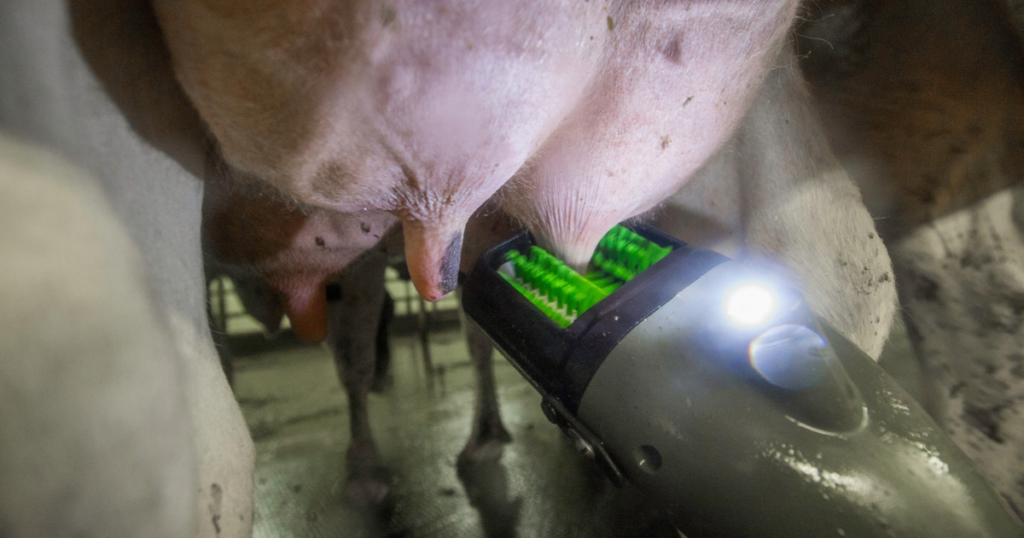
- At least 8+ seconds of meaningful tactile stimulation per cow
(whether that’s via a scrubber, forestripping or manual contact)
- A prep lag time of 90 to 120 seconds before unit attachment
- Consistency from cow to cow, shift to shift
This is where many dairies see a measurable difference, not by working faster, but by working more deliberately.
When stimulation is done correctly and consistently:
- Milk flow starts sooner
- Peak flow rates increase
- Unit-on time decreases
- Parlor throughput improves
- Cows are milked more completely
On the flip side, when stimulation is rushed or inconsistent:
- You’ll see bimodal curves
- Units stay on longer
- Cows leave milk behind
- Labor efficiency drops
Bringing It All Together
At the end of the day, milk letdown is not complicated, but it is often overlooked. We can focus on chemicals, equipment and protocols. All of those matter, but if we miss the biological trigger behind milk letdown, we’re leaving performance on the table.
Touch drives letdown. Timing supports it. Consistency makes it repeatable.
That’s the foundation of an effective prep routine, regardless of parlor size, labor structure, or level of automation. If you get that foundation right, everything else from milk quality to parlor efficiency gets a whole lot easier.