The Best Tool on the Farm Is Still the Human Behind It
January 16, 2026Why Your Milk Tank Isn’t Moving: Finding the Missing Piece
March 20, 2026

At the January annual meeting of the National Mastitis Council, a research team from Brazil presented something that hits directly at what we’ve been talking about for years at FutureCow:
Real, tactile stimulation matters.
The study, conducted on a commercial dairy in Sao Paulo, Brazil, evaluated the impact of implementing an automatic teat scrubber (FutureCow) as part of the prep routine. The end results were not theoretical. They were measurable, practical, and economically relevant.
Let’s break it down.
The Research Team
This project was led by: Felipe Z. Freitas, Amanda G. Valle, Angela N. Rodriguez, Cristian M. de Magalhaes Rodrigues Martins.
Evoluir Saúde do Leite, Patos de Minas, Minas Gerais, Brazil
Rúmina, Piracicaba, Sao Paulo, Brazil
Affiliations included: Evoluir Saude do Leite and Rumina.
The work was conducted under commercial conditions, not a small university tie-stall string, but a large, real-world herd.
Study Design
· 1,533 lactating cows
· Milked 3 times per day
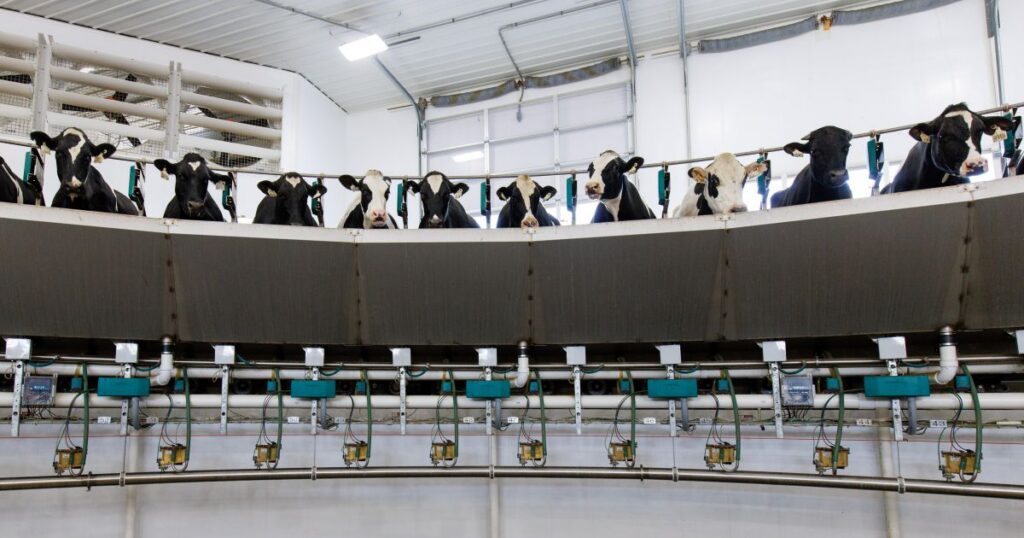
· Rotary parlor (50 stalls)
· Baseline data collected under conventional prep
· Automatic teat scrubber implemented January 2024
· Data compared before and after implementation
The FutureCow teat scrubber replaced traditional strip-cup, hand dipping and manual drying with a pre-dip sequence using our standardized scrubber process that combined cleaning, disinfection, and physical stimulation in one step / visit to the cow.
The last part, physical stimulation is where this gets interesting.
What Changed?
Average Milk Flow Rate Increased
Milk flow rate increased approximately +4.5% after implementation.
Higher flow rate doesn’t happen by accident. It reflects improved oxytocin release and better milk let-down. That means cows were physiologically more prepared when units were attached.
Bimodal Milk Flow Curves Decreased
The proportion of bimodal curves dropped by roughly 19%. Bimodal curves are a sign that the unit was attached before full milk let down. In other words: inadequate stimulation. A reduction here strongly suggests that consistent tactile stimulation improved udder prep timing and milk ejection dynamics.
Throughput Increased
Parlor throughput increased approximately +10.4% cows per hour. That’s not small. In a rotary parlor, throughput is money. Faster, more efficient milk harvest without increasing labor intensity is a big operational win.
Average Milking Time Adjusted
Changes in milking time reflected improved flow dynamics and fewer delays associated with delayed let-down. This automatically and naturally translates to reduced unit on time, improved comfort during milk harvest, which almost always equates to more milk and healthier cows over time.
Why Tactile Stimulation Matters
We’ve known biologically for decades that:
· Teat stimulation triggers oxytocin release
· Oxytocin drives milk ejection
· Without adequate stimulation, milk flow is delayed
But what this study reinforces is that standardized mechanical stimulation can improve consistency across cows and shifts. Humans vary. Fatigue varies. Technique varies. A scrubber that provides uniform tactile contact does not vary.
And that consistency shows up in:
· Flow rate
· Bimodality reduction
· Parlor throughput
· More stable milk ejection curves
A Practical Note on Interpretation
The authors did acknowledge that some management changes occurred around the time of implementation, which may slightly confound attribution. That’s honest science.
But when you see immediate reduction in bimodal curves, positive post-intervention slope in flow rate and significant throughput increase, it strongly suggests the stimulation component is doing real physiological work.
What This Means on Farm
When we talk about prep, this is what we’re really asking:
Are we just getting teats wet?
Or are we stimulating the cow?
There is a difference between applying disinfectant and actually creating tactile contact sufficient to trigger oxytocin release.
This Brazilian data supports what many progressive dairies are already seeing:
When prep includes true mechanical stimulation, cows milk more efficiently.
That is good for:
· Cow comfort
· Quality milk
· Parlor efficiency
· Labor consistency
· Equipment utilization
· Milk harvest dynamics
Final Thought
Milking performance is not just about equipment at attachment. It starts before the unit ever touches the teat. Standardized tactile stimulation improves milk ejection consistency and improved milk ejection improves flow rate.
That’s not marketing, that’s physiology supported by real world field data and it’s encouraging to see international research reinforcing what we’re focused on every day.